


Analysis of the Advantages of Dry Separation Compared to Wet Separation
Release time:
19 Sep,2025
Author:
Source:
Https://www.tsshenzhou.com/hangyenews/20211207.html
Abstract
The Kailuan (Group) Donghuantuo Mining Branch Coal Preparation Plant, designed with a production capacity of 1.5 million tons per year, is a mine-based preparation plant specializing in the processing of thermal coal. The coal type is gas coal, characterized by its relatively soft gangue, high content of fine coal particles, and coal that is wet, sticky, and difficult to screen. Additionally, both the coal and gangue tend to easily form mud-like suspensions, making it challenging for them to settle effectively. Originally, the plant used a 50–6mm heavy-medium separation method for coal preparation. However, due to changes in the underground coal quality over time, the recovery rate has dropped below 20%. After conducting screening and float-sink tests, it was found that separately treating the particle size range below 30–6mm with heavy-medium separation yields significantly better results, boosting the recovery rate to over 40%. Meanwhile, since the gangue content becomes more substantial in the 30mm+ size fraction, the plant has adopted a combined dry-method separation process to pre-screen and remove gangue, thereby enhancing both the recovery rate of clean coal and improving overall economic efficiency.
01、Structure of the FGX-24 Composite Dry Separation Machine
The FGX-24 composite dry separation machine consists of two FGX-12 composite dry separation machines. Its primary separation principles include the flip-and-peel separation method, self-generated medium separation, and segregation action. The FGX-24 composite dry separation machine is composed of components such as the separation bed, vibrator, air chamber, frame with suspension system, and material collection trough. The vibrator, driven by two vibration motors mounted on the separation bed’s motor frame, suspends the entire separation bed—complete with vibrators—via four steel cables connected to vibration-damping springs attached to the machine frame.
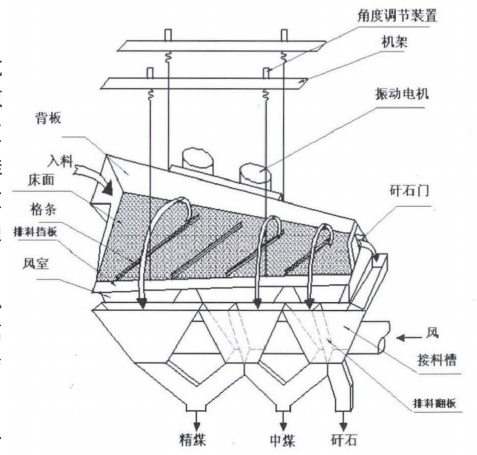
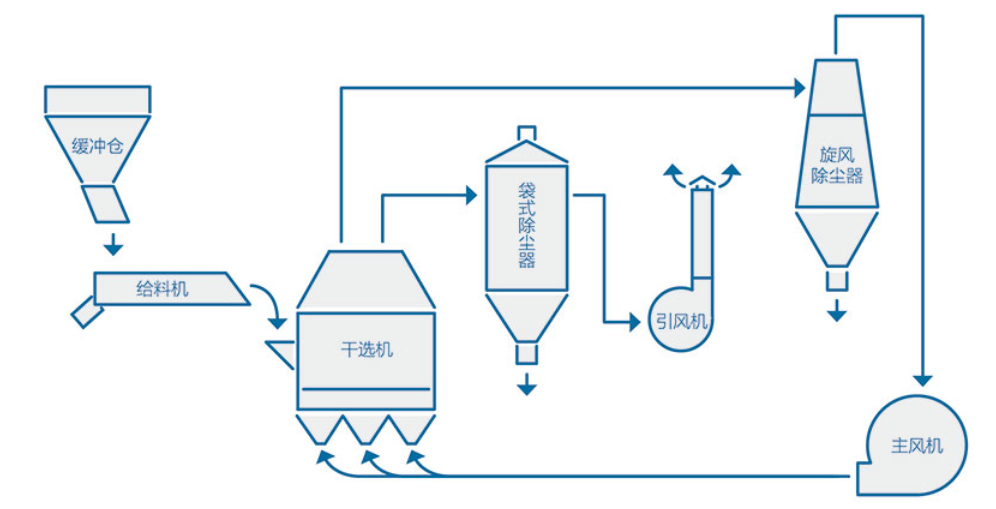
The separation bed consists of a right-trapezoidal bed surface covered with numerous air holes, a backplate, riffles, a discharge baffle, and a gangue gate. Below the bed surface, several air chambers are installed and connected to a centrifugal fan, with individual air valves controlling each chamber. The air chambers and the bed surface are securely fixed together, forming an integral part of the separation bed.
02、Commissioning Practice of the FGX-24 Composite Dry Separation Machine at Donghuantuo Coal Preparation Plant
During the commissioning process of the composite dry separation machine at the Donghuantuo Coal Preparation Plant, it did not fully achieve the expected results. The main issues encountered included the following:
(1) The coal gangue exhibits severe mudification, causing coal slime to circulate within the air ducts. During this circulation, the slime clogs the air vents in the screening bed, reducing airflow below the required level and negatively impacting the separation efficiency.
(2) There are many foreign objects in the underground raw coal, such as plastic bags, textile sacks, and small wooden boards, which have caused blockages in the screening bed and the air inlet of the induced draft fan.
(3) After sorting by the combined dry separation machine, limited adjustment ranges for both clean coal and gangue quantities lead to misalignment between the clean coal and gangue.
(4) The selected 30-80mm raw coal contains a significant amount of gangue, with considerable admixture of medium coal, and the gangue has a relatively high coal content.
(5) During operation, the composite dry separation machine handles coal that is relatively brittle. After raw coal is transferred into the machine, the circulating air generates a significant amount of dust around the equipment.
03、Analysis of Factors Affecting the Separation Performance of Composite Dry Separators
3.1 Raw Coal Quality
The coal seams in the Donghuantuo mine have relatively high external moisture content, classifying the coal as wet and sticky. In particular, the raw coal exhibits severe sludging, which, during the air separation process, gradually accumulates inside the air ducts due to airflow circulation. Over time, this buildup adheres to the duct walls, effectively blocking the airflow and reducing ventilation efficiency to some extent. Given that the combined dry coal-cleaning method is highly sensitive to air velocity, the presence of sticky coal significantly impacts the effectiveness of air-based separation.
3.2 Feed Particle Size
The Donghuantuo Coal Preparation Plant's composite dry separation machine primarily processes feed particles ranging from 30 to 80 mm in size, with relatively few fine-grained materials in the feed. As a result, the pulverized coal cannot effectively mix with the rising air current on the bed surface to form a self-generated gas-solid two-phase medium. Meanwhile, the 30-80 mm particle size range contains a significant amount of gangue, placing high demands on the equipment's ability to efficiently remove gangue during the separation process.
3.3 Raw Coal Gangue Content
The raw coal from the Donghuantuo Mine, with a particle size ranging from 30 to 80 mm, has a relatively high gangue content. When the coal quality underground is poor, the gangue content can exceed 60%. During operation of the composite dry separation machine, the large amount of gangue results in limited discharge capacity at the gangue outlet, leading to a higher proportion of misclassified clean coal and significantly impacting both the quality of the clean coal and the purity of the gangue.
3.4 Other Reasons
Due to waste generated from underground production and living activities being mixed with raw coal via conveyor belts, plastic bags enter the air separation equipment and, carried by the circulating air, make their way into both bag filters and cyclone dust collectors. From there, they travel along the pipelines to the lower part of the separation bed, severely clogging the screen holes and ultimately reducing airflow below the required level, thereby compromising the efficiency of the separation process.
04. Process, Equipment Optimization, and Retrofitting
4.1 Process Optimization
(1) Pre-crushing of raw coal feed ranging from 30 to 80 mm in size
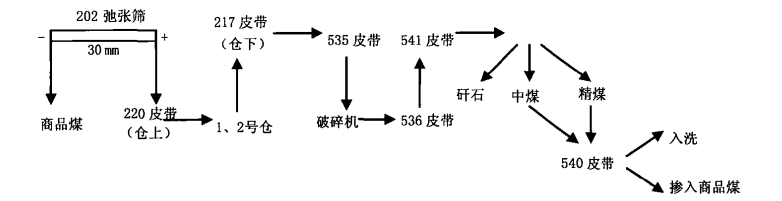
Originally, the design process involved feeding raw coal with a particle size of 30–80 mm directly into the composite dry separation machine for sorting. However, during commissioning and production, the sorting performance did not meet the desired standards. Through in-depth study and practical application of the separation principles underlying the composite dry separation machine, we optimized the process flow by adding an impact crusher to pre-crush the 30–80 mm material down to 40 mm. This pre-crushing step increased the content of pulverized coal, which, combined with the self-generated medium used in the process, significantly enhanced the overall sorting efficiency.
(2) Design and install the 540 transfer belt
Originally, the design process involved air separation of 30–80mm coal, after which the refined coal was directly sold as thermal coal. However, due to the constantly changing coal quality underground—particularly when the coal quality deteriorates and results in lower calorific value for the commercial product—the design now incorporates a 540 conveyor belt to blend the air-separated refined coal with the existing commercial coal, thereby enhancing the overall quality of the commodity. Additionally, the air-separating refined coal, once lightly cleaned to remove gangue, can also be transferred via the same 540 belt into the heavy-media system, further boosting the recovery rate of high-quality, heavy-media-washed coal.
(3) Adjust the ash-cleaning interval of the baghouse dust collector
Due to the relatively brittle coal quality of the raw coal at the Donghuantuo Mine, significant dust was generated in the surrounding areas. This not only resulted in losses of refined coal but also negatively impacted the working environment for employees. Therefore, by optimizing the PLC program for ash removal—reducing the original automatic ash-clearing interval from two hours to just 30 minutes—and implementing a separate transfer process via a coal distributor during ash-clearing operations, we were able to prevent secondary dust generation caused by multiple conveyor belts being used simultaneously. As a result of these improvements, the amount of dust in the surrounding area has been noticeably reduced.
(4) Optimized Process Flow
4.2 Retrofitting of the Combined Dry Separation Machine
(1) Add an inspection and cleaning access point for the air duct
Originally, the existing air ducts did not account for the blockage caused by sticky coal material, nor were maintenance and cleaning access points installed along the ducts. As a result, the ducts became severely clogged, significantly reducing the airflow—and consequently impacting the separation efficiency and effectiveness, making it impossible to guarantee the quality of the refined coal product. After adding maintenance and cleaning openings to the air ducts, operators can now more easily perform cleaning and inspections, ensuring unobstructed airflow and ultimately enhancing the overall separation performance.
(2) Install dampers on the induced draft fan
Originally, the existing induced draft fan was designed with an idealized consideration only for coal dust recovery, failing to account for the frequent presence of wet, fine-grained coal and numerous debris such as plastic bags underground—conditions that often led to blockages in the air ducts and sieve plates. After adding baffles, household waste like plastic bags can no longer be directly sucked into the induced draft fan, effectively diverting these materials and indirectly ensuring smooth airflow through the ducts.
(3) Extend the flap length between the chutes of each product
Originally, the two flaps separating raw coal, medium coal, and gangue were relatively short, which limited the range of adjustments when misaligned materials appeared between gangue and raw coal. When the calorific value of raw coal exceeded production requirements, operators had to adjust the raw coal flap to increase the mixing ratio of medium coal. However, due to the insufficient length of the flaps, even after reaching the adjustment limit, the raw coal still maintained a high calorific value, ultimately leading to a relative decrease in raw coal output. The same issue occurred when adjusting the amount of gangue. By extending the flaps, the adjustment ranges for both raw coal and gangue were significantly widened, allowing operators to fine-tune the flaps more flexibly and confidently. As a result, the quality control of raw coal and gangue became more precise, enabling the production of products that are not only more competitive in the market but also better aligned with customer needs.
(4) Increase the opening in the backboard of the gangue section
Originally, the sorting equipment was designed with larger amounts of gangue in mind, and an additional side gangue discharge port was added. At the Donghuantuo Mine, when the raw coal contains a high proportion of gangue—particularly in the 30-80mm size range—and the coal quality is poor, the gangue content can exceed 60%. As a result, the volume of gangue entering the system far surpasses the equipment's capacity to remove it, leading to a significant amount of mismatched material mixed with the clean coal. By installing an extra backplate gangue discharge port, we’ve significantly increased the gangue removal capacity, ensuring stable production of high-quality clean coal products.
05. Application Effect Analysis
The FGX-24 composite dry separation machine has been successfully applied at the Donghuantuo Coal Preparation Plant for over a year. After process optimization and equipment upgrades, the machine has been operating smoothly. Based on practical application at the Donghuantuo Coal Preparation Plant, its key advantages—compared to other separation equipment—include:
(1) Simple equipment
The composite dry separation machine features a simple equipment structure, occupies a small footprint, requires minimal civil engineering work, and boasts a short construction and installation schedule. The FGX-24 composite dry separation machine purchased by the Donghuantuo Coal Preparation Plant was successfully commissioned and put into production in just over one month—from equipment bidding and procurement to final debugging—ensuring uninterrupted production and significantly boosting economic efficiency.
(2) Low sorting costs
The raw coal from the Donghuantuo mine is inherently brittle, with a relatively high content of 30-80mm-sized gangue. According to the original design process, when this raw coal enters the primary washing system, the recovery rate of fine coal in the 30-80mm size range is low. Moreover, due to the substantial amount of gangue, the pipelines suffer severe wear and tear. By introducing the FGX-24 composite dry separation machine, the 30-80mm raw coal undergoes gangue removal, resulting in a calorific value exceeding 3900 Kcal/kg. This process achieves a high gangue rejection rate, with the residual coal content in the gangue dropping below 5%. Comprehensive analysis reveals that the cost of dense-medium separation is approximately 18 yuan/ton, while the cost of air separation is around 4 yuan/ton. As a result, the overall cost is reduced by 14 yuan/ton, yielding significant economic benefits.
(3) Simple operation
Compared to heavy-medium separation, the combined dry sorting machine does not require strict density control—instead, it only necessitates moderate adjustments to the flip plates between product chutes, the pre-screen baffles, or the angle of the screening equipment. Additionally, when coal quality is poor and the amount of gangue is relatively high, operators need to open the rear-panel gangue discharge port on-site to increase the volume of gangue removal. During operation, this system requires less hands-on intervention from field personnel compared to heavy-medium coal separation, and it doesn’t demand exceptionally high skill levels from employees either. In fact, staff can typically become proficient in operating the equipment after a brief training period.
(4) The composite dry separation machine requires minimal inspection and maintenance due to its simple design, few accompanying equipment needs, stable operation, compact footprint, and centralized layout.
06、Conclusion
After the FGX-24 composite dry separation machine was put into use at the Donghuantuo Coal Preparation Plant, washing and sorting costs were significantly reduced compared to heavy-medium separation, resulting in substantial economic benefits. The wind-sorting process at the Donghuantuo Coal Preparation Plant is designed for separating raw coal with a particle size range of 30–80 mm, characterized by a high gangue content and relatively high external moisture in the coal quality. Through optimization and modifications to the original process and equipment, the machinery now operates more reliably, leading to a noticeable decrease in production accidents and a significant boost in overall efficiency. This experience provides valuable insights for other coal preparation plants looking to utilize wind-sorting equipment for processing raw coal with similar characteristics.
Recommended reading
Coal Preparation Equipment Market: Technological Innovation Drives New Industry Trends
14 Nov,2025
Analysis of the Advantages of Dry Separation Compared to Wet Separation
19 Sep,2025
25 Jul,2025
Service Hotline
Service Hotline
Company Location
Xijintun Village, Mianshan Town, Jiexiu City, Shanxi Province
Please leave your contact information and we will contact you within 24 hours.

Scan QR code with WeChat
Contact us for more product information
Jiexiu Changyu Machinery Manufacturing Co., Ltd. | Powered by 300.cn | Privacy Policy